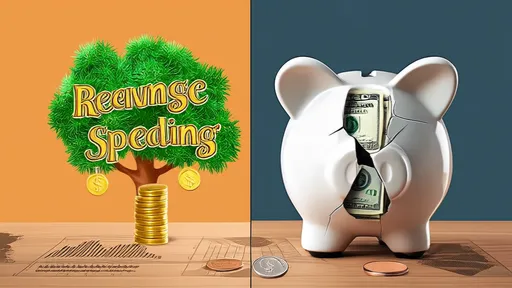
In the wake of global lockdowns and economic standstills, a curious dichotomy has emerged in consumer behavior that economists are calling the great behavioral divergence. Two terms have risen to prominence in financial discourse: revenge spending and fear saving. These phenomena represent not just temporary reactions to crisis, but potentially permanent shifts in how people approach money, value, and consumption.
The concept of revenge spending emerged as economies began reopening, capturing the explosive release of pent-up demand after months of restrictions. This wasn't merely catching up on delayed purchases—it represented something deeper, almost emotional in nature. Consumers who had been confined to their homes, separated from experiences and social connections, began spending with what appeared to be both calculated intention and emotional recklessness.
Luxury goods experienced unprecedented demand surges as those who maintained employment through the pandemic found themselves with accumulated savings and newfound perspective. The psychology behind this spending spree suggests that after being denied normalcy for so long, people weren't just buying products—they were purchasing normalcy, reclaiming experiences, and asserting control over their lives through consumption. This behavior pattern revealed that for many, spending had become therapeutic, a way to compensate for lost time and missed opportunities.
Meanwhile, running parallel to this consumption explosion, a completely opposite behavior emerged among different segments of the population. Fear saving became the prevailing financial strategy for those who experienced job insecurity, income reduction, or heightened anxiety about future stability. Where revenge spenders saw opportunity, fear savers saw vulnerability. This cautious approach to finances represented a fundamental shift in risk assessment and future planning.
The pandemic served as a brutal lesson in financial precarity for millions who had never before faced economic uncertainty. This experience created what behavioral economists call a "scarcity mindset" even among those whose financial situations eventually recovered. The memory of empty supermarket shelves, stimulus check dependencies, and employment instability created deep psychological imprints that continue to influence spending habits long after the immediate threat has passed.
What makes these behavioral shifts particularly significant is their apparent persistence. Initial assumptions that these were temporary reactions have given way to recognition that the pandemic may have permanently altered consumer psychology. The trauma of collective experience created neural pathways that continue to influence decision-making processes around money and security. This isn't merely about having more or less disposable income—it's about how people conceptualize the very purpose of money and its relationship to safety and happiness.
The revenge spending phenomenon has particularly transformed the luxury and experience economies. High-end restaurants report customers ordering more expensive bottles of wine without hesitation. Travel companies describe clients booking premium upgrades they would have previously considered extravagant. There's a palpable sense of "you only live once" mentality driving these decisions, suggesting that facing mortality during the pandemic has reshaped how people value experiences versus savings.
Conversely, fear saving has created what some economists are calling the "precautionary savings paradox." While higher savings rates theoretically benefit individual financial health and national economic stability, excessively conservative financial behavior can actually hamper economic recovery. When too many people save rather than spend, it reduces overall economic activity, potentially creating the very economic downturn that savers fear.
The divergence between these two behaviors also highlights and potentially exacerbates socioeconomic divides. Those who maintained stable employment and even increased savings during lockdowns now have greater financial freedom to engage in revenge spending. Meanwhile, those who faced financial hardship developed deeper risk aversion, creating a situation where economic recovery benefits some segments more rapidly than others, potentially widening existing wealth gaps.
Businesses across sectors are having to adapt to this new consumer landscape. Marketing strategies have shifted from emphasizing value to highlighting experience and emotional fulfillment for revenge spenders, while simultaneously developing messaging around security, reliability, and long-term value for fear savers. Companies that successfully navigate this split personality consumer economy are those that recognize both psychological drivers and tailor their approaches accordingly.
Policy makers face their own challenges in responding to these behavioral shifts. Traditional economic models struggle to account for the emotional and psychological factors driving these trends. Stimulus measures and economic policies must now consider not just financial indicators but behavioral patterns that defy conventional economic theory. The recognition that human decision-making is not always rational—particularly following collective trauma—requires new approaches to economic planning.
The long-term implications of this behavioral legacy remain uncertain. Will revenge spenders eventually revert to more conservative financial habits once the emotional high of post-pandemic freedom subsides? Will fear savers gradually regain confidence as economic stability continues? Or have these patterns become entrenched as new normal behaviors? What seems clear is that the pandemic has served as a massive behavioral economics experiment on a global scale, with results that will influence consumer behavior for years to come.
What makes this moment particularly fascinating for economists is that it provides real-world testing of theories that previously existed primarily in academic papers. The simultaneous occurrence of massive consumer spending alongside record savings rates defies traditional economic models that would predict more uniform behavior across populations. This divergence suggests that psychological factors—personal experiences, risk tolerance, and emotional responses to crisis—may play larger roles in economic behavior than previously acknowledged.
As we move further into the post-pandemic era, businesses, economists, and policy makers will continue to study these behavioral patterns. The companies that thrive will be those that understand the emotional underpinnings of both revenge spending and fear saving. The economists who succeed will be those who develop models that incorporate these psychological factors. And the societies that prosper will be those that recognize these behaviors as rational responses to extraordinary circumstances, and develop systems that acknowledge the very human emotions driving economic decisions.
The pandemic's behavioral economics legacy reminds us that numbers alone—unemployment rates, GDP growth, consumer price indexes—never tell the full story. Behind every economic statistic are human beings making decisions based on hope, fear, trauma, and resilience. Understanding this human element may be the most important economic lesson of all.

By /Aug 30, 2025

By /Aug 30, 2025

By /Aug 30, 2025

By /Aug 30, 2025

By /Aug 30, 2025

By /Aug 30, 2025

By /Aug 30, 2025

By /Aug 30, 2025

By /Aug 30, 2025

By /Aug 30, 2025

By /Aug 30, 2025
By /Aug 30, 2025

By /Aug 30, 2025
By /Aug 30, 2025

By /Aug 30, 2025
By /Aug 30, 2025

By Grace Cox/Nov 12, 2025

By /Aug 30, 2025
By /Aug 30, 2025

By /Aug 30, 2025